
Clogged Double Kitchen Sink: Why One Side Backs Up
One side of a double kitchen sink backs up because both basins drain through a single shared trap and a single wall line, and backed-up water rises through whichever basin offers the easier path. A double sink is not two drains. Each basin has a tailpiece, the two tailpieces join at a tee, and everything below the tee — the P-trap and the line into the wall — is shared. A clog below the junction cannot be escaped by using the other basin, and running water in one basin pushes water up into the other. This article explains the layout and what the backup pattern reveals about the clog's location.
How do the two basins share one drain?
The two basins share one drain through a tee fitting under the sink: each basin's tailpiece feeds the tee, and one trap below the tee serves both basins. The garbage disposal, where fitted, hangs under one basin and discharges through that basin's tailpiece into the same tee. Water from the plain basin, water from the disposal basin, and dishwasher discharge all converge at the tee and pass through the one trap. The shared parts are drawn out on the kitchen sink unclogging service page in the drain-parts section.
Why does water rise in the side nobody is using?
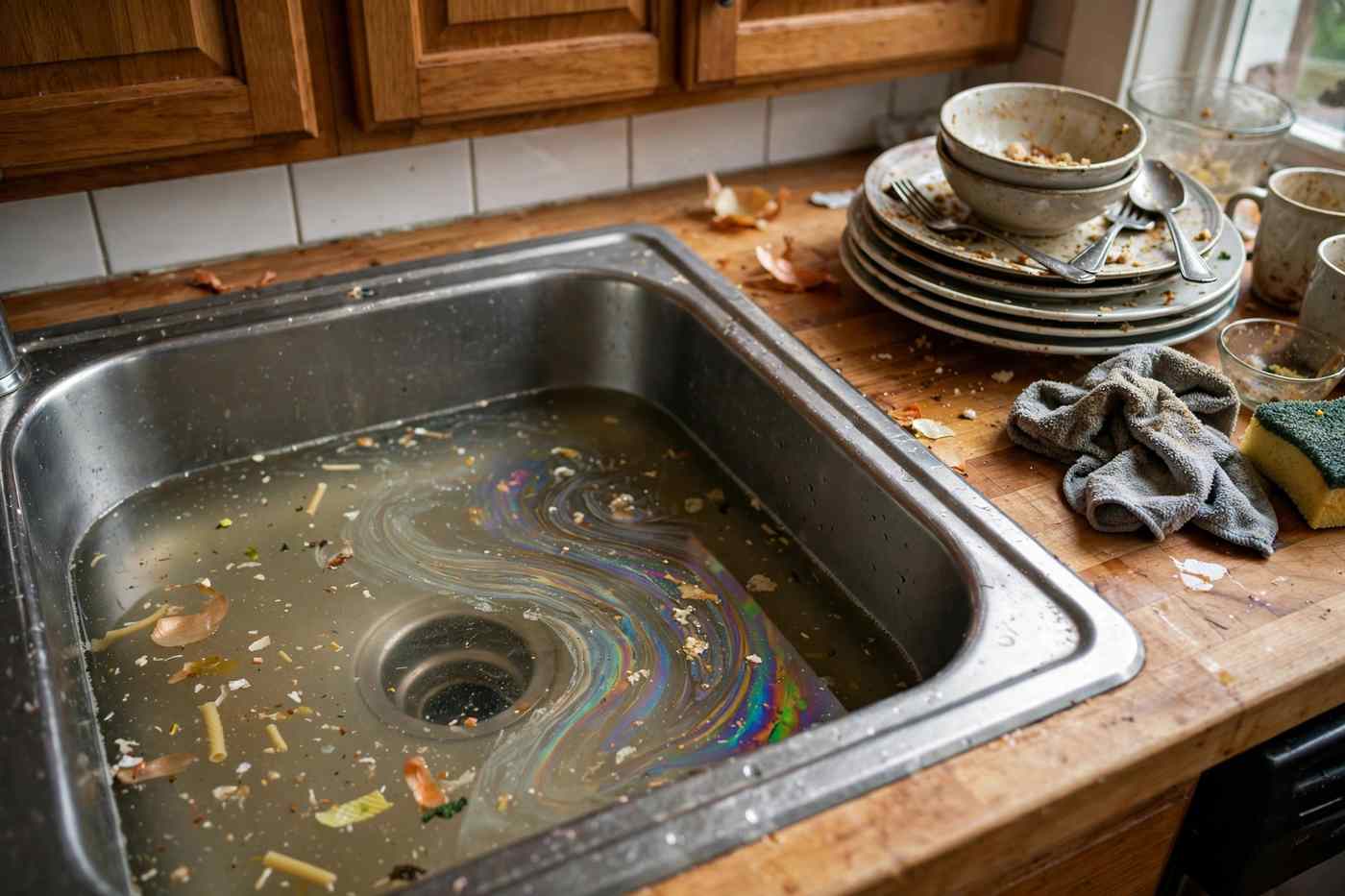
Water rises in the unused side because the clog blocks the shared line, and water under pressure takes the lowest-resistance exit — up the other basin's tailpiece. Running the faucet or the disposal adds water above the clog. The water cannot pass the clog, so the water fills the shared pipe and climbs both tailpieces. The basin where water appears first is often the disposal side, because the disposal outlet sits slightly lower, or the side where the water was not running, because the running side has the faucet stream masking the rise. The rising water carries ground food and grease particles from inside the line, which is why backup water looks dirty even in a clean sink.
What does the backup pattern say about the clog location?
The backup pattern locates the clog: one basin draining poorly on its own points to that basin's branch, and either basin backing into the other points below the tee. Three patterns cover most cases:
- One side slow, other side fine. The problem sits in the slow side's tailpiece or, on the disposal side, inside the disposal chamber.
- Both sides slow, neither backs up. The shared trap or the wall line is narrowed but still passing water — the slow-drain stage covered in kitchen sink draining slowly: 6 causes.
- One side backs up into the other. The shared line below the tee is blocked or nearly blocked. Plunging one basin mostly pushes water into the other basin instead of against the clog, unless the second basin is sealed with a stopper and a wet cloth over its drain.
Why does running the garbage disposal push water into the other basin?
Running the garbage disposal pushes water into the other basin because the disposal acts as a pump, and the pump pressure forces water against the clog and up the open tailpiece. The disposal spins water outward and downward with more force than gravity drainage. Against a blocked shared line, that force has one release: the plain basin. A garbage disposal backup into the second basin is one of the classic signs of a clog past the trap, listed on the kitchen sink unclogging Fort Pierce FL homepage. Switch the disposal off when water rises, because continued running only pumps more water into the basin.
Frequently Asked Questions
Can plunging fix a double sink that backs up side to side?
Plunging can fix a double-sink backup only when the second basin is sealed, so the plunger's pressure goes against the clog instead of up the other tailpiece. Set a stopper in the second basin and hold a wet cloth over the drain, or have a second person hold the stopper down. Unsealed plunging moves water between basins and leaves the clog in place.
Does a double-sink backup mean the main line is clogged?
No, a double-sink backup by itself means a clog in the shared kitchen line, and a main-line clog adds symptoms at other fixtures. Bathrooms draining slowly, a gurgling toilet, or water at a floor drain alongside the kitchen backup moves the diagnosis to the main line — the full pattern is in signs your kitchen clog is actually in the main line.
When should a homeowner call a professional about a double-sink clog?
Call a professional when both basins back up together, when sealed plunging does not restore drainage, or when the backup returns within days. Fort Pierce Sink Pros clears shared kitchen drain lines across Fort Pierce and St. Lucie County and can be reached at (772) 218-3739.
Double sink backing up in Fort Pierce? Call Fort Pierce Sink Pros.
Call (772) 218-3739