
Signs Your Kitchen Clog Is Actually in the Main Line
A kitchen clog is actually in the main line when fixtures beyond the kitchen show symptoms at the same time, because every drain in the house shares the main line. A clog in the kitchen branch affects the kitchen sink alone. A clog in the main line — the large pipe that carries all household drainage to the sewer or septic system — affects the whole house in a pattern. Recognizing the pattern matters, because clearing the kitchen trap or the kitchen wall line does nothing for a main-line blockage. The 5 signs below separate the two problems.
Sign 1: Do other fixtures back up at the same time?
Yes, simultaneous problems at a bathroom sink, tub, or laundry drain alongside the kitchen sink point to the main line. One branch clog cannot slow a fixture on another branch. When the kitchen sink, a shower, and a washing machine all drain slowly in the same week, the shared section — the main line — is the common explanation. Test the pattern by running water at two distant fixtures and watching whether each makes the other worse.
Sign 2: Does water appear at a floor drain or the lowest fixture?
Yes, water rising at the lowest drain in the house is a main-line sign, because backed-up water surfaces at the lowest open point. A main-line blockage pushes water backward, and the water exits at a basement or garage floor drain, a ground-floor shower, or a laundry standpipe — whichever sits lowest. In single-story Fort Pierce homes, the lowest point is often a shower drain or a laundry connection. Sewage-tinted water at a low fixture while the kitchen sink runs is a main-line pattern, not a kitchen pattern.
Sign 3: Do toilets gurgle or bubble when the sink drains?
Yes, gurgling or bubbling in a toilet bowl when the kitchen sink or dishwasher drains means air is being pushed and pulled through the system by a blockage downstream. Drains move air as well as water. A main-line clog traps air, and running water compresses the trapped air until the air escapes through the nearest water seal — often a toilet bowl, where the escape shows as bubbles. A kitchen-branch clog cannot produce symptoms at a toilet.
Sign 4: Does the whole house drain slowly after heavy water use?
Yes, house-wide slow drainage that worsens after a shower, a laundry load, or a dishwasher cycle points to a main line that can no longer pass the combined volume. A partly blocked main line handles one fixture at a time and fails when fixtures overlap. The kitchen is often where the problem is noticed first, because kitchen drainage is watched daily. The overlap pattern is the giveaway: single fixtures cope, combined use backs up.
Sign 5: Is there a sewage smell at several drains?
Yes, a sewage smell at several drains at once points past the kitchen, because a single kitchen trap problem smells at the kitchen only. A main-line blockage holds wastewater in the system, and gases from the held water rise at multiple fixtures. Smell at the kitchen alone has kitchen causes — biofilm, trap food, a dry trap — covered in why a kitchen sink drain smells bad. Smell across the house belongs to the main-line pattern.
Frequently Asked Questions
Can a main-line clog be cleared from the kitchen sink?
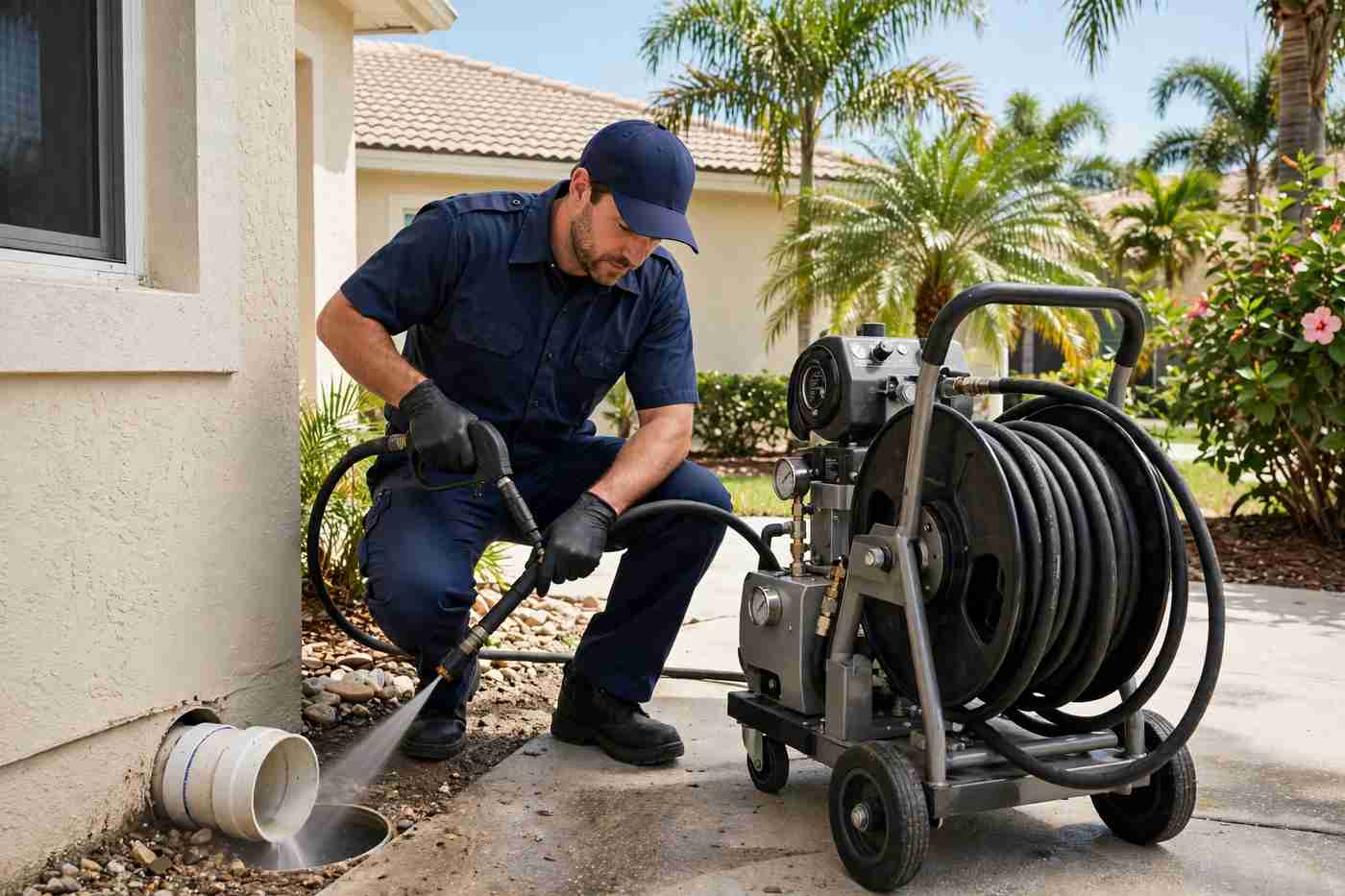
No, a main-line clog needs clearing through a main cleanout access point with a larger cable machine, because the kitchen branch is too narrow and too far from the blockage. The kitchen auger work described on the kitchen sink unclogging service page addresses the branch line. A main-line job starts at the cleanout, usually an access cap in the yard or near the foundation.
What causes a main line to clog?
Main lines clog from years of combined household buildup, and in many Florida yards also from tree roots entering through pipe joints. Roots grow toward the moisture at joints, catch passing material, and build a mat inside the pipe. Settled or shifted pipe sections create low spots where material collects. The cause decides the remedy, and the cause is identified during the clearing.
When should a homeowner call a professional about a suspected main-line clog?
Call a professional as soon as 2 or more of the signs appear together, and stop running water into the system if sewage is surfacing at a low fixture. Fort Pierce Sink Pros serves Fort Pierce and St. Lucie County and can be reached at (772) 218-3739. Kitchen-only symptoms are covered on the kitchen sink unclogging Fort Pierce FL homepage.
Several drains acting up at once in Fort Pierce? Call Fort Pierce Sink Pros.
Call (772) 218-3739