
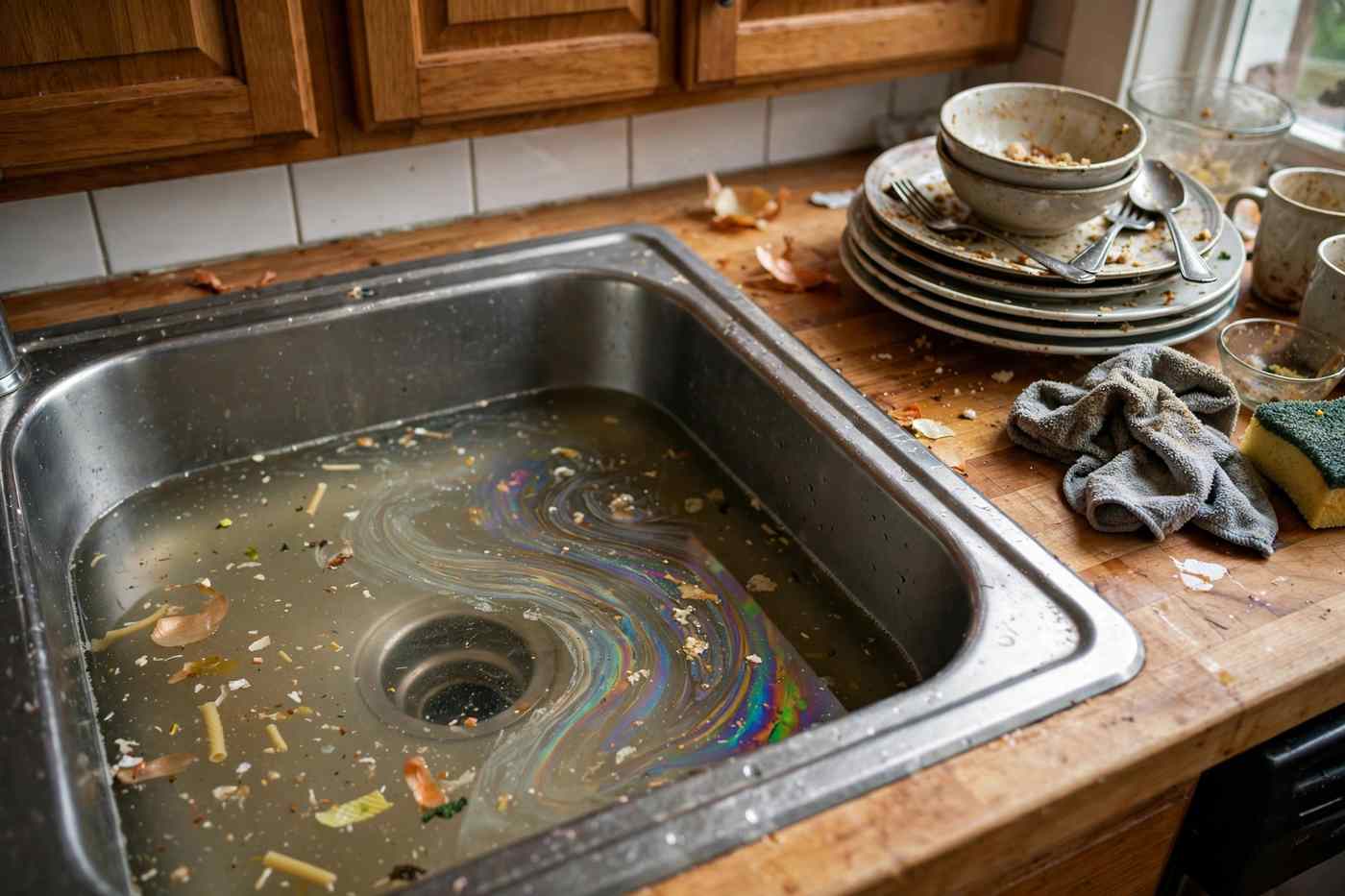
Water Backing Up in Your Kitchen Sink When the Dishwasher Runs
Water backing up in the kitchen sink when the dishwasher runs means the shared drain line past the dishwasher connection is clogged or narrowed. The dishwasher does not have a separate drain. The dishwasher pumps its water into the garbage disposal inlet or into a branch of the sink tailpiece, and that water leaves through the same trap and wall line as the sink water. A partial clog that still handles faucet flow cannot handle the dishwasher's pumped discharge, and the overflow rises into the sink basin. The pattern is diagnostic: backup only during the dishwasher drain cycle points at the shared line, not at the dishwasher.
How does dishwasher water reach the sink drain?
Dishwasher water reaches the sink drain through a hose that connects to the garbage disposal inlet or to a dishwasher branch on the tailpiece. The dishwasher pump pushes several gallons (roughly 6 to 10 liters per drain cycle) out in a short burst. The hose rises to a high loop under the countertop or to an air gap fitting before descending to the connection; the high loop keeps sink water from flowing backward into the dishwasher. Everything below the connection — trap, wall line, main line — is shared between the two appliances. The shared layout is the same one described on the kitchen sink unclogging service page.
Why does the backup appear only during the dishwasher cycle?
The backup appears only during the dishwasher cycle because the dishwasher delivers water faster than a narrowed line can pass water, while a faucet delivers water slowly enough for the narrowed line to keep up. A faucet flows at a moderate, steady rate. The dishwasher pump empties the tub in a burst that can exceed the capacity of a grease-narrowed pipe. The difference between the two flows is why a sink can seem fine all day and then fill with cloudy dishwasher water every evening. A line in this state is a clog in progress, and the gradual stage is covered in kitchen sink draining slowly: 6 causes.
Can the garbage disposal be part of the problem?
Yes, a garbage disposal packed with residue narrows the first section the dishwasher water must pass, and a jammed disposal blocks the dishwasher path entirely. Dishwasher water enters through the disposal on most installations, so disposal chamber buildup throttles dishwasher drainage before the water reaches the trap. Run the disposal with cold water to clear the chamber, and check whether the dishwasher backup improves. A disposal that hums without grinding is a separate fault, covered in garbage disposal humming but not working.
What should a homeowner check first?
Check 3 things first: the disposal chamber, the trap, and whether the sink alone has started draining slowly. Run the disposal with cold water for 30 seconds and retry a dishwasher drain cycle. Clean the trap out if the trap has not been checked. Note whether faucet water now pools in the basin, because a sink that backs up under its own faucet has a clog that has grown past the dishwasher-only stage. Stop running the dishwasher until the line is cleared if water rises high in the basin, since repeated cycles push more food-laden water into a line that cannot pass the water.
Frequently Asked Questions
Is the dishwasher broken when water backs up into the sink?
No, the dishwasher is usually working correctly, and the backup is a drain problem rather than a dishwasher problem. The pump is delivering water on schedule; the shared line cannot accept the water. The one dishwasher-side exception is a blocked drain hose or a clogged air gap, which a check of the hose path can separate from a line clog.
Why is the backup water cloudy and full of particles?
The backup water is dishwasher discharge — hot water carrying the food soil washed off the load — that has nowhere to go. The water rises into the basin because the basin is the lowest open point above the clog. The particles settle in the basin as the water slowly drains.
When should a homeowner call a professional about a dishwasher backup?
Call a professional when the backup continues after the disposal chamber and trap are cleared, or when the sink also drains slowly on its own. Fort Pierce Sink Pros clears shared kitchen drain lines across Fort Pierce and St. Lucie County and can be reached at (772) 218-3739. The kitchen sink unclogging Fort Pierce FL homepage covers the other backup patterns.
Dishwasher backing water into your sink in Fort Pierce? Call Fort Pierce Sink Pros.
Call (772) 218-3739