
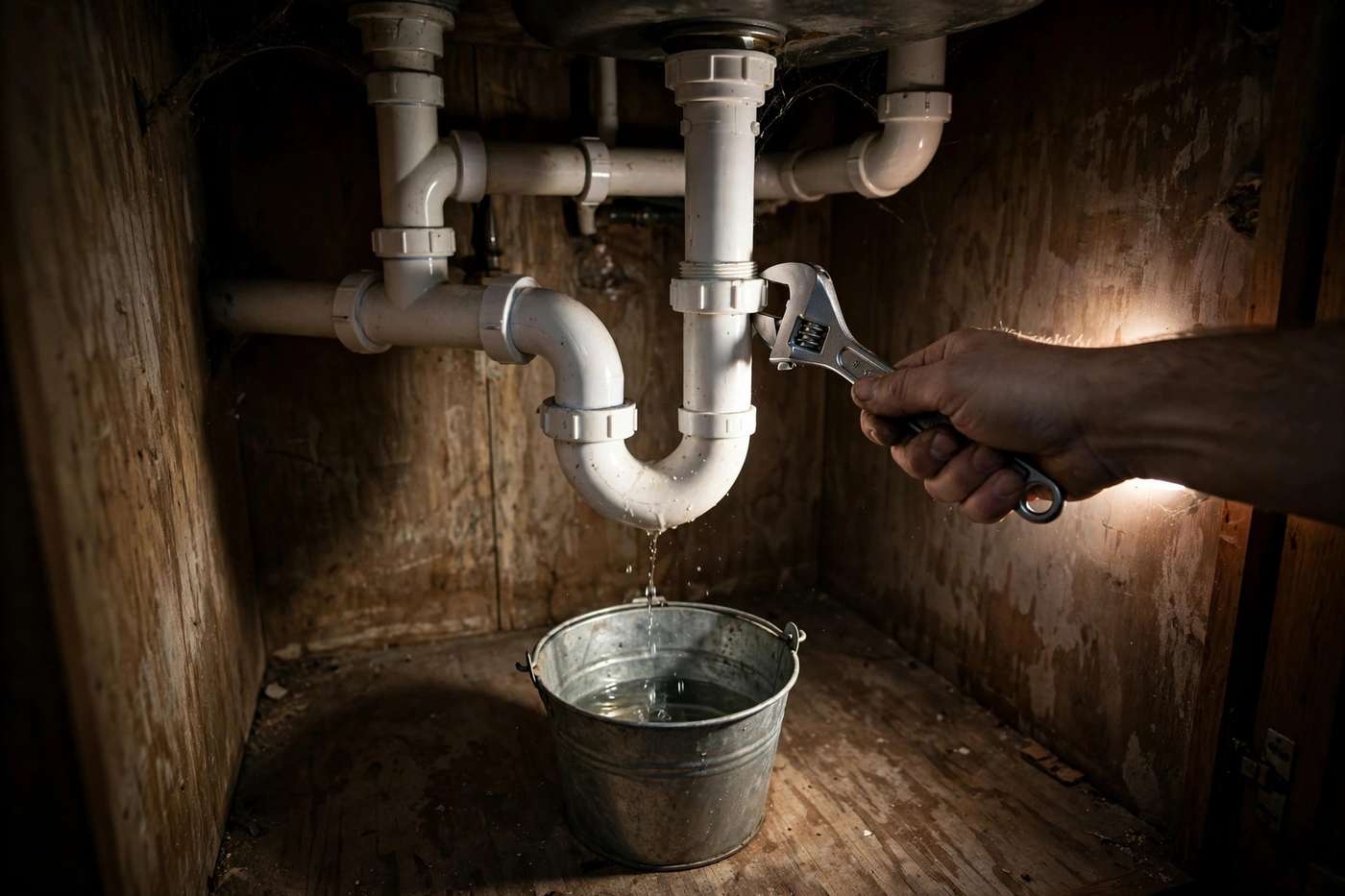
Kitchen Sink Leaking Under the Cabinet? Common Causes
A kitchen sink leaking under the cabinet comes from one of 5 places: the trap connections, the tailpiece, the garbage disposal mount, the water supply lines, or the dishwasher hose. Water under the cabinet damages the cabinet floor and the flooring beneath, and the damage grows while the source stays unidentified. The source can be found by pattern: a leak that appears only when the sink drains is a drain-side leak, and a leak that drips steadily whether or not the sink runs is a supply-side leak. Dry every surface under the sink, then run one fixture at a time and watch where the first drop forms.
Are the trap connections leaking?
Yes, loose or misaligned trap slip nuts are the most common under-cabinet leak, and trap leaks drip only while water drains. The P-trap connects with slip-joint nuts and washers that loosen over time, shift when items stored under the sink bump the trap, or seal poorly after a trap cleaning if a washer seats crooked. Run water into the basin and watch each nut. A drip at a nut often stops with a hand-tightening of the nut; a nut that keeps dripping after tightening usually has a worn or cracked washer. Trap anatomy and cleaning are covered on the kitchen sink unclogging service page.
Can the tailpiece or strainer body leak?
Yes, the tailpiece leaks where the tailpiece meets the strainer body, and corrosion on an older metal tailpiece can weep along the pipe wall. The strainer body seals to the sink with putty or a gasket, and an aged seal lets water track down the outside of the tailpiece during drainage. Corroded metal develops pinholes that show as dampness and green or white crust on the pipe. A tailpiece leak appears high under the sink, close to the basin — higher than a trap leak. Water that drips from the strainer area only when the basin holds a full load of water points at the strainer seal.
Can the garbage disposal leak from the mount or the body?
Yes, a garbage disposal leaks at 3 points: the mounting flange at the sink opening, the dishwasher inlet connection, and the bottom of the body when internal seals fail. A flange leak drips from the top of the unit while the basin drains. An inlet leak drips when the dishwasher runs its drain cycle. A leak from the bottom of the body — water emerging from the motor housing rather than from a pipe joint — means the internal seal has failed, and the unit needs replacement rather than a fitting adjustment. Disposal faults that come with noise and humming are covered in garbage disposal humming but not working.
Are the supply lines or the dishwasher hose leaking?
Yes, supply lines drip independently of sink use, and the dishwasher hose leaks only during the dishwasher drain cycle — the timing separates the two. Supply lines carry pressurized water to the faucet, so a supply leak drips steadily, day and night, and often shows as a wet spot that never dries. The dishwasher drain hose connects to the disposal inlet or the tailpiece branch, and a cracked hose or a loose clamp sprays or drips while the dishwasher pumps out. A leak that appears on a schedule matching dishwasher use belongs to the dishwasher path, which is also the path involved in water backing up when the dishwasher runs.
Frequently Asked Questions
How can a homeowner find the exact leak source?
Dry all pipes and fittings with a towel, place dry paper towels under each joint, and run one water source at a time — faucet, then disposal side, then a dishwasher cycle. The first paper towel to get wet marks the leaking joint. Check from the highest fitting downward, because water from a high leak runs down pipes and can drip off a lower joint, imitating a low leak.
Is a small under-sink drip safe to ignore for a while?
No, a small drip under the sink keeps the cabinet floor damp continuously, and continuous dampness rots cabinet material and grows mold on the wet surfaces. Even a slow leak delivers water every day. A bucket catches the drip while the source is being identified, and the bucket is a temporary measure, not a fix.
When should a homeowner call a professional about an under-sink leak?
Call a professional when the source cannot be found, when a fitting keeps leaking after tightening, when metal pipe is corroded, or when water comes from the bottom of the disposal body. Fort Pierce Sink Pros serves Fort Pierce and St. Lucie County and can be reached at (772) 218-3739. The kitchen sink unclogging Fort Pierce FL homepage covers the drain side of under-sink plumbing.
Water under your kitchen sink in Fort Pierce? Call Fort Pierce Sink Pros.
Call (772) 218-3739